

Therapeutic rupture
Exploring the limits of "therapy is political."

Hello, friends, and happy fall. It’s Peak Leaf out here on the east coast. Hope you’ve bought your one-dollar tiny pumpkin etc.

Over the past couple weeks, a number of friends and readers have sent me the recent NY Mag piece Does it matter what your therapist thinks about Israel?.
The piece gets into some conversations between therapists and their clients about how personal politics about Israel present in the therapy room, and the impact it has on the therapeutic relationship. It details relationship ruptures when a client or therapist reveals their ideology or politics, sometimes ending said relationship altogether. I was struck by the following quote, shared by one therapist cited in the article:
“I don’t think it would be safe or comfortable for someone who identifies as a Zionist to work with me — for them,” they said. “There would be a level of dissonance that would get in the way of their healing.”
“There’s a genocide of the Palestinian people happening, and there is a lot of focus on Jewish needs, anxieties, and perceived antisemitism,” Alex continued. “If there’s anything I say that I’d want you to publish, it would be that we have to decenter Jewish feelings.”
Ideologically, I get it. But in the context of providing psychotherapy to individuals, I ask my fellow social justice-oriented colleagues in the field: Whom is this statement meant to benefit?
A popular refrain you hear these days: “Therapy is political.” A largely younger generation of therapists have rejected the notion of the “blank-slate” clinician and are unafraid to share their politics, ideologies, and personalities online (present company included). This is in service of addressing that power dynamics exist in the therapy room, just like they do anywhere else. It is also an acknowledgment that therapists are human people, and as such, exist within social contexts of their own. Therapists, like other humans, cannot ever be truly objective or neutral. (Before you say it: Neither can AI.)
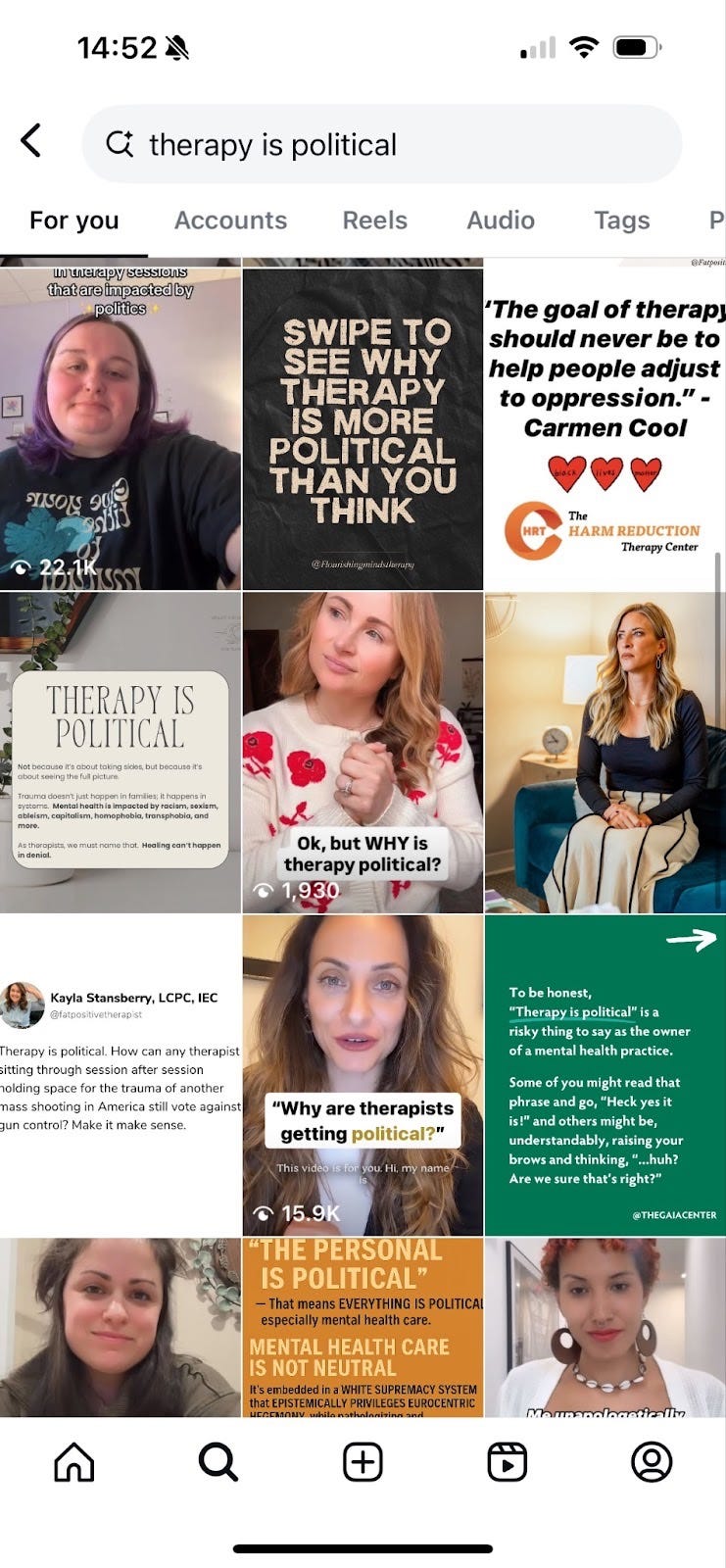
Therapy is also political because identities are politicized. In therapy, we identify and process the ways that our social realities shape us. The ways certain identities are narrativized in culture, religion, and political rhetoric have an impact on the ways we see ourselves and each other. In the room, it matters.
In the therapy room, clients are encouraged to share their whole selves. This includes those parts that are unresolved, conflicted, and taboo. Sometimes, they share thoughts or feelings that are dark, or that might be offensive. Sometimes I feel offended myself.
This is normal. I’m a human. But it’s not really my personal problem; it’s a work puzzle. Depending on what’s appropriate in that moment, I might encourage the client to interrogate the thoughts, look for the emotions behind the statement to understand why they feel that way, share my reaction with the client to benefit the therapeutic relationship, or just internally notice my feeling and move on (and talk about it in supervision). Maybe I’ll bring it up again later. Ideally, the decision I make about what to do with that feeling is the decision that I think has the best chance to benefit the client. I’ll probably still need some opportunity to process on my own.
Back to that quote: The therapist in question states that for them to work with a client who identifies as Zionist would be “unsafe.” I’m curious about the line between danger and discomfort here. It’s an important distinction: Safety is essential, comfort is fickle. In therapy, we learn to sit with discomfort, embrace it, trust that we’ll get through it. They also say the level of dissonance would be interruptive. When taking on new clients, as clinicians, we must ensure our own safety. We take into account our comfort. But eluding discomfort altogether is just never gonna happen.
Being a therapist can be intimidating. Clients get mad at me, they yell, they unleash big feelings, they talk about suicide, they talk about violence. I’d say my emotional boundaries are pretty well cultivated, but I still cry once in a while after a session. I feel that it’s a requirement of my job that my threshold for emotional safety be higher than the average person’s. I am the person that my clients can talk about this stuff with, and trust that I won’t freak out. My capacity to hold and witness dark, messy shit is my trade skill.
I can understand and empathize with wanting to work with clients whose values I share. I’d say that to prioritize that, however, risks centering me. To have narrow policies about what my clients must believe risks casting out clients who may benefit from being in a therapeutic relationship with someone who thinks differently.
By rejecting political differences in the therapy room, as clinicians, we risk pushing those clients who may benefit from a nonjudgmental space in a relentlessly judgmental world into a situation where they may reject therapy altogether. Moreover, we risk continuing to stratify mental healthcare along political lines and alienate the people who seek it.
The people who we turn away may also be vulnerable to being exploited by the explicitly right wing partisan therapists.
And they’re out there. Websites like Conservative Counselors provide directories of therapists who have committed to the following core beliefs:
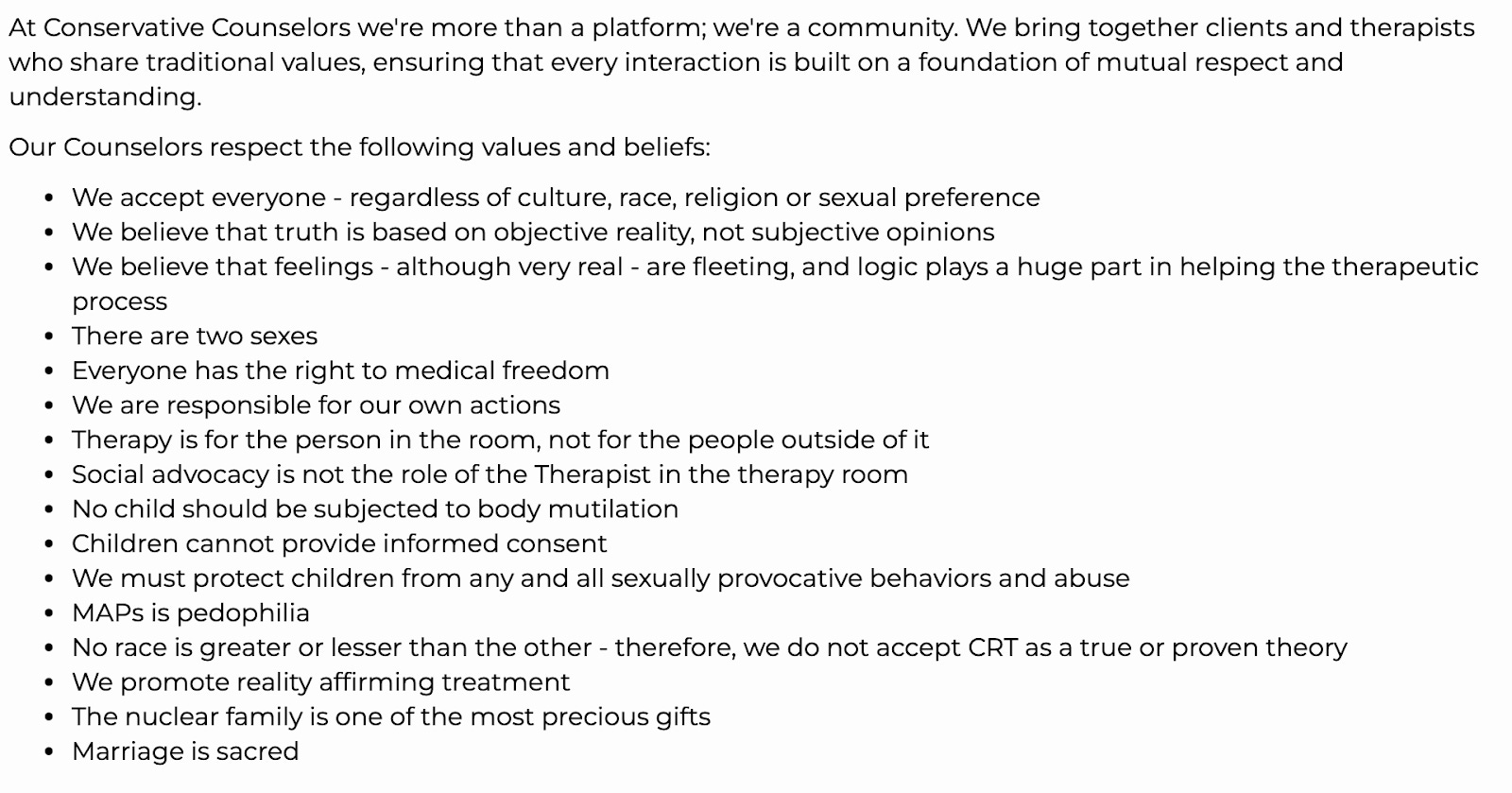
Frightening.
Of course, I absolutely support the desire to find out your therapist’s politics. As a client myself, I do want to work with a therapist who agrees with me on certain things. I also feel differently when it comes to my personal relationships. We all have the right to choose who we spend time around. Finally, I understand that not every therapist is for every person, and vice versa. Every therapist has issues they just can’t work with for various reasons. Again, we’re people. This is complicated stuff. I could go on and on.
Morality and ethics are interconnected, but they’re not one and the same. Tolerance and nondiscrimination are fundamental principles to our work, and that applies in every direction. We have a right as business operators to choose who we work with, and we also have a code of ethics as therapists to do no harm. Balancing these aspects of the work can be tricky.
I just think we (therapists) ought to be cautious here about how we draw lines in the sand. From any angle, clinicians are specifically trained to hold differences – even when they’re differences we don’t like.
-
This month in bad therapy news
It looks like the Supreme Court is going to overturn the ban on “conversion therapy” for minors (in quotes because it is definitely not therapeutic). The case was brought by a licensed counselor in Colorado who is claiming that the ban violates her first amendment protections, even while working within the scope of her professional licensure.
Think: Doctors are not allowed to say that a raw food diet is the best treatment for cancer, right? That’s not speech; it’s standards.
-

The pop culture therapy canon grows
I recently watched Black Bag on a plane, and oh brother. Immediate all-timer entry for bad movie therapist. At least the movie knows that – not always the case (The Departed, I’m looking at you).
I also saw After the Hunt last week, which took a New Yorker cartoon of a psychoanalyst and plopped him on the screen in the form of Michael Stuhlbarg. The guy is speaking German and discussing Freud at dinner parties. There’s literally a scene where his wife Julia Roberts lays on his long couch while he holds a notepad. Silly, but honestly, the most fun part of a movie that was not much fun otherwise. What can I say. I’m a Stuhlbarg head.

Thanks for reading! If you haven’t caught my recent appearance on the NO SUCH THING podcast, listen here. And as always, send me your ideas and feedback, or leave me a comment to discuss. Messy and incomplete thoughts welcome. <3
Have you read Soul Searching by William J. Doherty? (I haven't read it yet. It's been on my list for ages.) I think it's relevant to these questions and was curious if you have an opinion on it.
I share your skepticism about the therapist who said it wouldn't be "safe" for a Zionist to be in treatment with her. Really? She can't set her views aside long enough to listen without judgement while someone explores feelings about an issue that are different from hers? How is that helpful?